 |
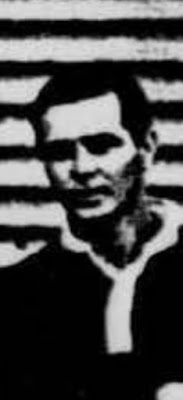
One of the rare images of Peter Coppock, cropped from a representative team photo |
The last thing Peter George Coppock ever did was participate in a Weston FC training game at the Homestead on 7 September 1922. It would’ve been a buoyant session given that the team had beaten a powerful Pyrmont team 3-2 there on the previous weekend. It’s easy to imagine players milling in the changing shed having just run in to escape a downpour, ready to maybe have an ale, or maybe just go home, have dinner and an early night ready for a shift in the morning. The heavens put paid to that. As the players were wondering what to do next a bolt of lightning struck the shed with a terrible force killing Peter Coppock outright, young Gordon Hadfield passing away soon after, despite the presence of Doctor Wood. It also left three of their teammates stunned and reeling, one dangerously ill.
Peter Coppock was a champion player and a great servant of the game. According to the Newcastle Herald, he "was recognised as the best left half in the northern district." The article also points out that he "went through the war with distinction." He was decorated for gallantry twice and seems to have been a respected and valued comrade by many. Having played representative football, during the war he became a busy promoter and advocate of soccer among the Armed Forces in Europe. He organised games and wrote tremendous reports on those games that found their way back to Australia, being published in the Newcastle papers.
 |
34th Battalion soccer team. 20th November 1918, Fricort, France.
Peter is likely holding the ball in the front row. From Harrower collection. |
His death hit the entire football community hard. The Herald lamented (pessimistically as it turned out) that the "Weston club looked like having a big say in two competitions, but the sad event has quite disheartened them, and they will miss one who was, perhaps, their most popular player and beloved of them all." Seemingly undaunted, the club powered towards the end of the season, collecting the Kerr and Stevenson Cups.
Coppock's Weston career was such a short interlude. His footballing credentials had to a great extent already been established. In his early 30s, his skills had been developed and his footballing wisdom was clear. And while he may well have been on the edge of further promotion within Australian football's ranks, possibly into the Australian team, such was his form, Weston was not a crucial part of his formation.  |
| In Memorium notices 1923 |
That story belongs to other clubs, particularly Merewether Advance, the club he left to go fight in the AIF. Yet Weston is where he died, to become part of the club's litany of misfortune.How Coppock came to be at Weston is probably an interesting tale. It appears he was having trouble finding or keeping work in Adamstown so had temporarily left his family in Merewether and was living with Mr Beaney who might well have assisted him in finding work. The fact that his family didn't move to Weston might speak to the temporary nature of his transfer. This we will never know.
The community rallied round with a well-attended funeral and a match to raise funds for Coppock's family. At Weston's awards night, the 1922 cup medals were awarded to all players. Coppock's were given to his youngest son, Ralph in a scene observers felt was indescribably sad. One reporter mentioned a "pathetic incident was the handing over of the medal won by the late Peter Coppock ... to his infant son, aged 15 months."
Article on Coppock on the NNSWF website
The following article appeared in the Newcastle Sun, Friday 8 September 1922, page 5
STRUCK DEAD BY LIGHTNING
Two Soccer Footballers Killed
THREE OTHERS INJURED SHOCKING TRAGEDY AT WESTON
Two footballers were killed and three others seriously shock-ed by lightning at Weston during the fierce electrical storm yesterday afternoon. They were, with 13 of their-mates, in a shed at the Homestead ground, changing clothes after a practice match. Those killed were:--
PETER COPPOCK (32), married, miner at Hebburn colliery, living at Weston. GORDON HADFIELD (16), car driver, of Weston. The injured men are:— William Tweddle (30), John Robinson (17), and Samuel Wood (17).
There was no warning. The players had been driven from the field by a deluge of rain, and they were preparing for home. Coppock, one of Weston's most dependable players, was just donning his shirt when the flash came. Richardson and Hayes, youths, who did good work for Weston seniors against West Wallsend on Saturday week, were standing on each side of Coppock. Suddenly, Coppock fell dead. In another part of the dressing-shed, Hadfield quickly succumbed. All the occupants of the shed were seriously affected. At nine o'clock last night, one of the victims was seen wandering through Weston's streets in a dazed manner. He was quickly transferred to safety. Three of the players suffered severely from shock. They were taken to the Kurri District Hospital at Dr. Woods' orders. Last night, when the body of Coppock lay in the Kurri District Hospital, it was arranged that a presentation should be made him at the residence of Mr. Penman, an enthusiastic footballer of Weston. Shortly after the accident, Mr. W. Beaney, secretary of the South Maitland Soccer Football Association, with whom the late Mr. Coppock had been staying, together with Mr. George Kennedy, motored to Merewether, where Mrs. Coppock and her two children reside. Mr. 'Jock' Stevenson, managing director of J. Stevenson, Ltd., drove to the home of Hadfield and offered his condolences.


